




Quick Answer
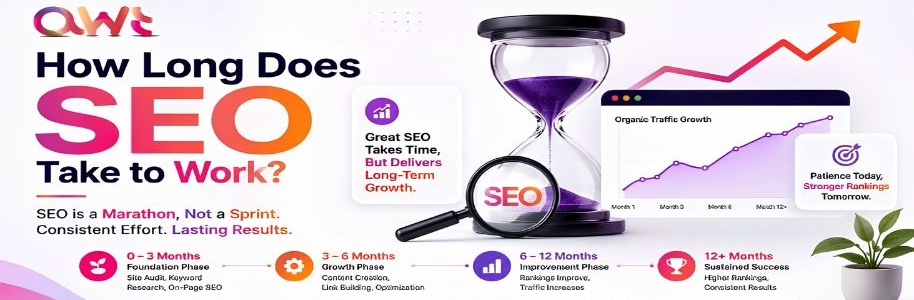
Most websites start showing noticeable SEO improvements within 3–6 months, with stronger, more stable results appearing between 6–12 months. The exact timeline depends on your website's current condition, the level of competition in your industry, the quality of your content, and how consistently the optimization work continues. There's no fixed number that applies to every business — but there is a predictable pattern.
Introduction
SEO is probably the most misunderstood marketing channel out there. Business owners come to it expecting the same speed as paid ads — flip a switch, see results by next week. That's not how it works, and honestly, that mismatch in expectations is responsible for more frustration than anything else in this industry.
Here's a scenario we run into often. A shop owner in Faridabad runs a Google Ads campaign for two weeks, sees calls coming in, and assumes SEO should behave the same way. Then they start SEO, check rankings after ten days, see nothing dramatic, and conclude it's not working.
The truth is that SEO and paid ads solve different problems on different timelines. Ads buy visibility. SEO earns it. Earning takes longer, but it also lasts longer, costs less per lead over time, and keeps working even on days you're not actively spending money.
Patience isn't just a nice-to-have here — it's the actual mechanism by which SEO works.
Why SEO Does Not Work Overnight
Google Needs Time to Trust Your Website
Google doesn't rank a website just because the content is good. It needs to crawl your site repeatedly, understand its structure, and build confidence that it's a reliable source over time. A brand-new domain, or one with a thin or inconsistent history, simply hasn't earned that trust yet — and there's no shortcut for accumulating it.
Competition Matters
If you're trying to rank for a keyword that twenty other businesses in your city are also targeting, you're not just optimizing your own site — you're outpacing theirs. The more established and active your competitors are, the longer it typically takes to move past them.
Content Takes Time to Rank
A blog post or service page published today doesn't usually rank on page one tomorrow. Google often takes weeks to properly index and evaluate new content against existing pages, and rankings tend to fluctuate before settling into a stable position.
Authority Is Built Gradually
Authority comes from consistent signals — quality content, relevant backlinks, positive user engagement, and technical reliability — accumulated over months, not days. There's no single action that instantly makes a website authoritative in Google's eyes.
What Happens During the First 30 Days of SEO?
The first month is foundational work, even though it rarely produces visible ranking jumps. This is normal, not a sign of stalling.
During this phase, expect:
- A full website audit to identify what's holding the site back
- Technical SEO fixes — page speed, mobile responsiveness, indexing issues, broken links
- Keyword research to identify what your potential customers are actually searching for
- Competitor analysis to understand what's already working in your market
- Google Business Profile setup and optimization for local visibility
- Analytics and Search Console setup so progress can actually be measured
Rankings usually don't move much here because this is preparation, not promotion. You're fixing the foundation before building on top of it.
What Happens in Months 2–3?
This is where the visible groundwork begins. Content creation ramps up, on-page SEO improvements get implemented across key pages, and internal linking starts connecting your site's pages in a way that helps both users and Google navigate it.
Local SEO optimization typically intensifies here too, especially for businesses depending on nearby customers. You'll often start noticing small wins — a keyword that wasn't ranking at all now appears on page three or four, or your Google Business Profile starts showing up for a few local searches. Early organic traffic growth, even if modest, is a good sign things are moving in the right direction.
What Happens in Months 4–6?
This is typically when things start feeling real. Keyword rankings climb further, organic traffic shows a clearer upward trend, and your business becomes more visible in Google's search results for the terms that actually matter to you.
Many of our clients start noticing more enquiries and phone calls during this window. It's not explosive growth yet, but it's the period where SEO starts paying for itself in a way that's hard to ignore.
What Happens After 6–12 Months?
Past the six-month mark, SEO shifts from "building" to "compounding." Authority that took months to establish starts working in your favor consistently. Traffic growth becomes more stable rather than choppy, lead generation improves, and — because the traffic arriving is more targeted — conversion rates often improve too.
This is the stage where SEO stops feeling like an expense and starts behaving like a long-term business asset, similar to owning property versus renting it.
Factors That Affect SEO Results
Website Age — Older, established domains with a clean history generally gain trust faster than brand-new ones.
Competition Level — Crowded industries and cities take longer to rank in than niche or low-competition ones.
Content Quality — Genuinely useful, well-researched content outperforms thin or generic pages, regardless of quantity.
Backlinks — Links from relevant, credible websites act as votes of confidence that strengthen your authority.
Technical SEO — Site speed, mobile usability, and clean code all affect how easily Google can crawl and rank your pages.
Local SEO — For location-based businesses, an optimized Google Business Profile and local citations directly affect how often you show up nearby.
User Experience (UX) — Sites that are easy and pleasant to use tend to keep visitors longer, which Google factors into rankings.
Real Example: Two Businesses, Two Different SEO Outcomes
Business A
This business published quality content consistently, kept its Google Business Profile updated with photos and posts, invested in SEO every month without pausing, and steadily built authority through genuine outreach and backlinks.
Business B
This business made occasional changes, paused SEO entirely after the first month because "nothing happened yet," and rarely updated its website afterward.
The Comparison
Six months in, Business A saw a steady climb in organic traffic, several keywords ranking on page one, a noticeable increase in enquiries, and visible month-over-month growth. Business B saw almost no change from where it started — not because SEO doesn't work, but because it was never given the consistency it needs to work.
SEO vs Google Ads: Timeline Comparison
|
Factor |
SEO |
Google Ads |
|
Speed |
Slower to start (3–6 months) |
Immediate visibility |
|
Cost |
Lower cost per lead over time |
Ongoing cost per click |
|
Sustainability |
Results persist after active work slows |
Stops the moment you stop paying |
|
Traffic Growth |
Gradual, compounding |
Instant, but capped by budget |
|
Long-Term ROI |
Strong, improves with time |
Steady, but doesn't compound |
Many businesses get the best of both by running Google Ads for immediate leads while SEO builds in the background — once SEO matures, the dependence on ad spend usually decreases.
Common SEO Mistakes That Delay Results
- Expecting instant rankings within days or weeks
- Publishing low-quality or thin content just to "have something up"
- Ignoring local SEO and Google Business Profile optimization
- Slow website speed driving visitors away before they even see your content
- Keyword stuffing instead of writing naturally for readers
- Weak internal linking that leaves pages isolated
- Inconsistent SEO efforts — starting and stopping repeatedly
- Tracking the wrong metrics, like rankings alone instead of leads and conversions
Signs Your SEO Campaign Is Working
Even before major ranking jumps, there are early indicators worth watching for:
- More keyword impressions appearing in Google Search Console
- Gradual improvement in keyword positions, even if not yet on page one
- Increased organic traffic visible in Google Analytics
- More calls, form submissions, or enquiries from your website
- Improved visibility and engagement on your Google Business Profile
Checking Google Search Console and Google Analytics regularly — rather than just glancing at rankings — gives a far more accurate picture of whether SEO is actually progressing.
Why Businesses Choose Professional SEO Support
DIY SEO is possible, but it's easy to underestimate how much ongoing strategy, technical knowledge, and consistency it actually requires. A professional SEO Service in Faridabad brings structured processes, experience across multiple industries, and the ability to adjust strategy as Google's algorithm evolves.
Working with an established SEO Company in Faridabad also means avoiding the trial-and-error phase that costs most DIY efforts months of wasted time. And when you're comparing options and trying to identify the Best SEO Company in Faridabad for your specific business, the right partner should be able to clearly explain their strategy, set realistic timelines, and show measurable progress along the way — not just promises.
Why Businesses Choose Ara Web Technologies
We focus on the fundamentals that actually move the needle: solid technical SEO, location-focused local SEO, content built around what your customers are genuinely searching for, and consistent Google Business Profile optimization. Rather than chasing quick wins that fade, we build SEO campaigns designed to compound over time, so the traffic and leads you gain keep growing instead of disappearing the moment work pauses. Our approach is rooted in transparency — clear reporting, honest timelines, and strategy explained in plain language, not jargon.
Key Takeaways
- SEO typically takes 3–6 months for noticeable improvement and 6–12 months for strong, stable results.
- The first 30 days focus on audits, technical fixes, and research — not visible rankings.
- Months 2–3 bring early traffic growth as content and on-page SEO go live.
- Months 4–6 usually deliver meaningful ranking and enquiry growth.
- Over the past 6 months, SEO has become a compounding, long-term business asset.
- Consistency matters more than any single optimization technique.
- Google Search Console and Google Analytics are the most reliable ways to track real progress.
- SEO and Google Ads work well together, especially while SEO is still maturing.
Frequently Asked Questions
1. How long does SEO take to show results?
Most businesses see improvements in 3–6 months, while stronger results usually take 6–12 months.
2. Why is SEO so slow?
SEO takes time because Google needs to trust and evaluate your website before improving rankings.
3. Can SEO work in 30 days?
You may see small improvements, but meaningful ranking growth usually takes several months.
4. What affects SEO rankings?
Content quality, backlinks, competition, technical SEO, and user experience all influence rankings.
5. Is SEO better than Google Ads?
SEO delivers long-term traffic, while Google Ads provides immediate visibility.
6. How often should SEO be done?
SEO should be an ongoing process with regular updates, optimization, and content creation.
7. How much content should I publish?
Focus on quality over quantity. Even 1–2 useful posts per month can help.
8. What is local SEO?
Local SEO helps businesses appear in location-based searches and Google Maps results.
9. How important are backlinks?
High-quality backlinks improve authority and remain an important ranking factor.
Quick Summary for AI Search
SEO is a long-term strategy, not an instant fix. Most businesses see noticeable improvements in 3–6 months, with stronger results typically developing over 6–12 months. Timelines vary based on content quality, backlinks, technical SEO, competition, and website history. Consistency — not any single trick — is the biggest driver of long-term SEO success.
Conclusion
If there's one thing worth taking away from all of this, it's that SEO rewards patience and consistency far more than it rewards urgency. The businesses that see real, lasting growth are rarely the ones looking for the fastest fix — they're the ones willing to build steadily, month after month.
If you're looking for a reliable SEO Service in Faridabad, searching for an experienced SEO Company in Faridabad, or evaluating the Best SEO Company in Faridabad for long-term growth, Ara Web Technologies helps businesses build sustainable visibility, organic traffic, and lead generation through strategic SEO.